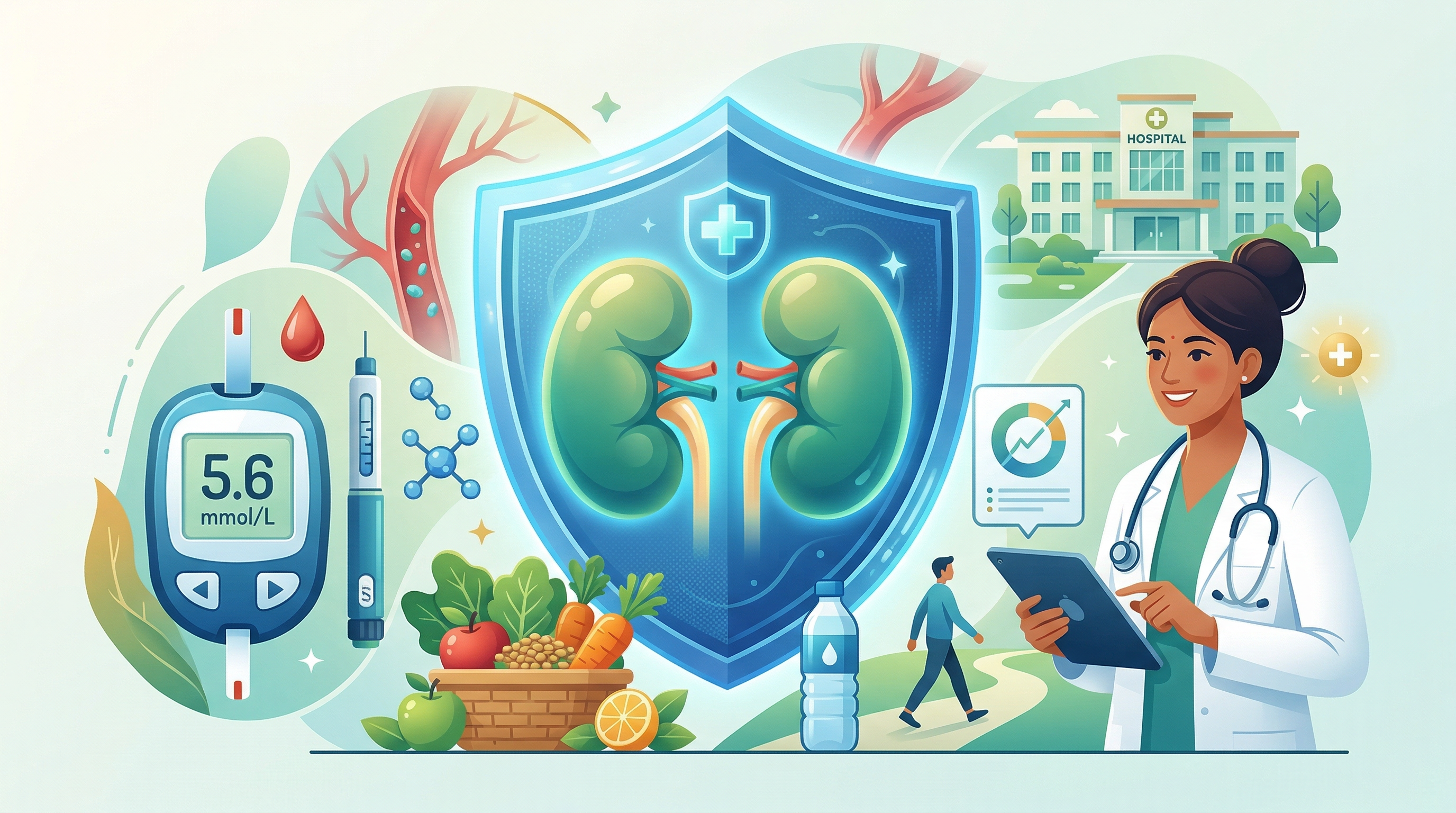
1. Why Diabetes Attacks Your Kidneys
Your kidneys contain approximately 1 million tiny filtering units called glomeruli. Each glomerulus is a bundle of microscopic blood vessels that filter waste products from your blood while keeping essential proteins like albumin inside. Think of them as extremely fine sieves — they let waste through but keep the good stuff in your blood.
When blood sugar remains chronically elevated, several destructive processes begin:
- Glycation damage: Excess glucose binds to proteins in the kidney's filtering membrane, making it thicker and less efficient. This process is similar to how high HbA1c forms — sugar molecules "sticking" where they shouldn't.
- Hyperfiltration: In early diabetes, kidneys actually work overtime to compensate. They filter more blood than normal, which sounds helpful but actually wears out the glomeruli faster — like running a car engine at redline constantly.
- Inflammation: High blood sugar triggers inflammatory molecules (cytokines) that cause scarring (fibrosis) in kidney tissue. Once scarred, that tissue never recovers.
- Blood vessel damage: Diabetes damages the tiny blood vessels feeding the kidneys, reducing blood supply and causing tissue death in patches.
The insidious part? Kidney damage from diabetes is completely silent in the early stages. You won't feel any pain, notice any symptoms, or suspect anything until you've already lost 50-60% of kidney function. This is why regular testing is non-negotiable for every diabetic.
2. The India-Specific Problem: Shocking Statistics
India faces a unique "double burden" when it comes to diabetes and kidney disease:
| Metric | India Data (2025-26) |
|---|---|
| Total diabetics | 101 million (ICMR 2024) |
| Prediabetics | 136 million |
| Diabetics with some kidney damage | ~30-35 million (estimated) |
| Patients on dialysis | ~3.4 lakh (and growing 10-12% yearly) |
| Cost of dialysis per month | ₹15,000-40,000 (private); ₹2,000-5,000 (government) |
| Kidney transplants per year | ~12,000 (vs. 2 lakh+ needed) |
| Average age of diabetic nephropathy onset | 45-55 years (10 years earlier than Western countries) |
Several factors make Indians particularly vulnerable:
- Late diagnosis: Studies show the average Indian diabetic is diagnosed 4-7 years after the disease begins, meaning kidney damage may already be underway at diagnosis.
- Poor blood sugar control: The ICMR-INDIAB study found that only 25-30% of diagnosed diabetics in India achieve the target HbA1c of below 7%.
- High salt diet: Indian cuisine relies heavily on salt, pickles (achaar), papad, and processed snacks — all of which worsen kidney stress and blood pressure.
- Limited access to nephrologists: India has approximately 2,500 nephrologists for 1.4 billion people. Most are concentrated in metros, leaving rural and semi-urban patients underserved.
- Genetic susceptibility: South Asians carry gene variants (like APOL1 and MYH9) that increase kidney disease risk independent of diabetes control.
3. The 5 Stages of Diabetic Kidney Disease
Diabetic kidney disease progresses through well-defined stages. Understanding where you stand helps you and your doctor take the right action:
| Stage | eGFR (mL/min) | Urine Albumin | What's Happening | Action Needed |
|---|---|---|---|---|
| Stage 1 | ≥90 (normal) | Normal or trace | Hyperfiltration — kidneys work overtime | Tight blood sugar + BP control. Annual testing. |
| Stage 2 | 60-89 | Microalbuminuria (30-300 mg/g) | Early filter damage — small amounts of albumin leak | Start ACE inhibitor/ARB. Dietary changes. Test every 6 months. |
| Stage 3a | 45-59 | Moderate albuminuria | Moderate damage — toxin clearance reduced | Nephrology referral. SGLT2 inhibitor. Protein restriction. |
| Stage 3b | 30-44 | Heavy albuminuria (>300 mg/g) | Significant damage — symptoms may begin | Strict diet. Potassium monitoring. Medication review. |
| Stage 4 | 15-29 | Very high | Severe damage — preparing for dialysis/transplant | Transplant evaluation. Fistula creation for dialysis access. |
| Stage 5 | <15 | Very high | Kidney failure — cannot sustain life without intervention | Dialysis or kidney transplant required. |
🍛 Free 7-Day Indian Diabetic Meal Plan — breakfast to dinner, all Indian recipes
Download Free →4. Early Warning Signs You Must Not Ignore
While early diabetic kidney disease has no symptoms, watch for these signs as the disease progresses:
Early Signs (Stage 2-3) — Often Missed
- Foamy or frothy urine: This is one of the earliest visible signs. Excessive protein in urine creates a persistent foam that doesn't disappear quickly — similar to beaten egg whites. If your urine consistently foams, get a UACR test immediately.
- Swelling around eyes in the morning: Puffy eyelids upon waking that resolve by afternoon suggest protein loss from kidneys (nephrotic features).
- Ankle or foot swelling: Mild pitting oedema — press your shin bone with your thumb for 5 seconds. If an indent remains, fluid retention is present.
- More frequent urination at night: Nocturia (waking 2+ times to urinate) can indicate the kidneys are losing concentration ability.
- Unexplained fatigue: As toxins build up and anaemia develops (kidneys produce erythropoietin for red blood cells), persistent tiredness sets in.
Late Signs (Stage 4-5) — Urgent
- Persistent nausea and loss of appetite
- Metallic taste in mouth
- Severe itching all over the body (uraemic pruritus)
- Muscle cramps and restless legs at night
- Shortness of breath from fluid overload
- Confusion or difficulty concentrating (uraemic encephalopathy)
- Significant weight gain from fluid retention (5+ kg in a week)
5. Essential Kidney Tests Every Diabetic Needs
These tests are your early warning system. They're affordable, widely available across India, and can save you from dialysis:
| Test | What It Measures | Normal Range | How Often | Cost in India |
|---|---|---|---|---|
| UACR (Urine Albumin-to-Creatinine Ratio) | Protein leakage from kidneys | <30 mg/g | Yearly (6-monthly if abnormal) | ₹300-600 |
| Serum Creatinine + eGFR | Kidney filtration efficiency | eGFR >90 | Yearly (3-6 monthly if abnormal) | ₹200-400 |
| Blood Urea Nitrogen (BUN) | Waste product clearance | 7-20 mg/dL | Yearly | ₹150-300 |
| Serum Electrolytes (Na, K, Cl, HCO3) | Electrolyte balance | K: 3.5-5.0 mEq/L | If eGFR <60 | ₹400-800 |
| Kidney Ultrasound | Kidney size and structure | 9-12 cm length | Baseline + as needed | ₹500-1,500 |
| HbA1c | 3-month blood sugar average | <7% (diabetics) | Every 3 months | ₹400-700 |
How to Read Your Reports
UACR (Urine Albumin-to-Creatinine Ratio):
- <30 mg/g: Normal — kidneys are healthy. Retest annually.
- 30-300 mg/g (Microalbuminuria): Early kidney damage. Reversible with treatment. Start ACE inhibitor, tighten blood sugar control.
- >300 mg/g (Macroalbuminuria): Significant kidney damage. See a nephrologist urgently.
eGFR (estimated Glomerular Filtration Rate):
- >90: Normal kidney function
- 60-89: Mildly reduced — monitor closely
- 45-59: Moderately reduced — nephrology referral recommended
- 30-44: Significantly reduced — active nephrology management needed
- <30: Severe — prepare for dialysis/transplant evaluation
6. Seven Proven Ways to Protect Your Kidneys
The good news: diabetic kidney disease is largely preventable. Here are seven evidence-backed strategies:
1. Maintain HbA1c Below 7%
The UKPDS study proved that every 1% reduction in HbA1c reduces the risk of kidney complications by 37%. For most Indian diabetics, the target should be HbA1c below 7%. If you already have early kidney disease, aim for 7-7.5% — going too low can cause dangerous hypoglycaemia.
2. Control Blood Pressure Below 130/80 mmHg
High blood pressure is the #2 killer of diabetic kidneys after high blood sugar. The ADVANCE trial showed that reducing systolic BP by just 5 mmHg reduced kidney disease progression by 21%. Tips:
- Reduce salt intake to <5g/day (about 1 teaspoon)
- Limit pickles (achaar), papad, processed namkeen
- Take BP medications consistently — don't skip doses
- Monitor BP at home with a digital monitor (₹1,500-3,000)
3. Get Annual Kidney Tests (UACR + eGFR)
Starting from the day you're diagnosed with diabetes, get UACR and eGFR tested annually. If either is abnormal, increase to every 3-6 months. Early detection gives you a 5-10 year window to reverse or halt progression.
4. Stay Hydrated — But Don't Overdo It
Dehydration concentrates glucose and toxins in the kidneys. Aim for 2-2.5 litres of water daily in moderate Indian climate, 3+ litres in summer. However, if you already have advanced kidney disease (Stage 4-5), your nephrologist may restrict fluid intake.
5. Stop Smoking Immediately
Smoking constricts blood vessels feeding the kidneys and accelerates kidney damage by 30-50%. Indian smokers with diabetes reach dialysis 5-8 years earlier than non-smokers. Bidis are equally harmful — the "natural" leaf wrapper doesn't make them safer.
6. Avoid Unnecessary Painkillers (NSAIDs)
Over-the-counter painkillers like ibuprofen (Brufen), diclofenac (Voveran), and naproxen are directly toxic to diabetic kidneys. Many Indians self-medicate with these for joint pain, headaches, or fever. Use paracetamol (Crocin, Dolo) instead, and always check with your doctor before taking any painkiller regularly.
7. Maintain a Healthy Weight
Obesity increases intra-glomerular pressure — essentially making your kidneys work harder. For Indian adults, aim for BMI below 23 (lower than the Western cutoff of 25, due to higher visceral fat in South Asians). Even a 5-7% weight loss improves kidney function markers.
7. Indian Diet for Kidney Protection
Diet plays a crucial role in protecting diabetic kidneys. Here's what works in the Indian context:
Foods That Protect Your Kidneys
| Food | Why It Helps | How Much |
|---|---|---|
| Lauki (bottle gourd) | Low potassium, diuretic properties, kidney-friendly vegetable | 1 bowl sabzi, 3-4 times/week |
| Tinda and parwal | Low potassium, low oxalate, easy to digest | Regular rotation in meals |
| Cabbage and cauliflower | Anti-inflammatory, low potassium, high fibre | 1 serving daily |
| Red bell pepper (Shimla mirch) | Rich in vitamins A, C — antioxidant protection for kidneys | Add to salads and sabzis |
| Onion and garlic | Anti-inflammatory, flavonoids protect kidney tissue | Use freely in cooking |
| Apple (with skin) | Pectin fibre, low potassium fruit — safe for kidneys | 1 medium apple/day |
| Egg whites | High-quality protein without phosphorus overload | 2-3 egg whites daily |
| Olive oil / Mustard oil | Anti-inflammatory fats — better than refined oils for kidneys | 2-3 tsp/day for cooking |
Foods to Limit or Avoid
| Food | Why It's Harmful | Alternatives |
|---|---|---|
| Excess salt, pickles, papad | Raises blood pressure → accelerates kidney damage | Lemon, jeera, herbs for flavour |
| Coconut water (excess) | Very high potassium — dangerous if eGFR <60 | Plain water, nimbu pani (low sugar) |
| Banana (if eGFR <60) | High potassium (422 mg per banana) | Apple, papaya, guava |
| Tomato (excess) | High potassium when consumed in large amounts | Moderate amounts in cooking are fine |
| Rajma and chole (excess) | High protein + potassium + phosphorus | Moong dal, masoor dal (lower phosphorus) |
| Paneer (excess) | High phosphorus dairy protein | Tofu, limited paneer (50g/day max) |
| Cola and packaged drinks | Phosphoric acid directly harms kidneys | Homemade chaas (buttermilk), herbal tea |
| Processed meats | High sodium, phosphate additives | Fresh fish, chicken (moderate portions) |
Sample Kidney-Friendly Indian Meal Plan
Breakfast (8:00 AM): Moong dal chilla (2 pieces) with mint chutney + 1 cup masala chai (low sugar)
Mid-morning (11:00 AM): 1 medium apple + 5-6 soaked almonds
Lunch (1:00 PM): 1 cup rice + lauki dal (bottle gourd with masoor dal) + cabbage sabzi + small salad (cucumber, radish) + 1 tsp ghee
Evening snack (4:00 PM): 1 cup roasted makhana (fox nuts) + green tea
Dinner (7:30 PM): 2 multigrain rotis + palak (spinach) with tofu + raita (low-fat curd with cucumber)
8. Medications That Protect Diabetic Kidneys
Beyond lifestyle changes, specific medications have proven kidney-protective effects. Discuss these with your diabetologist or nephrologist:
ACE Inhibitors / ARBs (First Line)
Drugs like ramipril, enalapril (ACE inhibitors) and telmisartan, losartan (ARBs) reduce pressure inside the kidney's filtering units and decrease protein leakage by 30-50%. Every diabetic with microalbuminuria should be on one of these — even if blood pressure is normal.
SGLT2 Inhibitors (Game-Changer)
Dapagliflozin (Forxiga), empagliflozin (Jardiance), canagliflozin (Invokana) — these diabetes medications have shown remarkable kidney protection in landmark trials (DAPA-CKD, CREDENCE, EMPA-KIDNEY). They reduce the risk of kidney failure by 30-40% independent of blood sugar lowering. The DAPA-CKD trial was stopped early because the benefits were so clear.
SGLT2 inhibitors are now available as affordable generics in India (dapagliflozin at ₹8-15/tablet), making them accessible. Ask your doctor about adding one if you have any degree of kidney damage.
Finerenone (Kerendia) — Newest Option
Approved based on the FIDELIO-DKD and FIGARO-DKD trials, finerenone is a non-steroidal mineralocorticoid receptor antagonist that further slows kidney decline when added to ACE/ARB therapy. It's now available in India and recommended for diabetics with persistent albuminuria despite standard treatment.
9. When to See a Nephrologist
Your regular diabetologist can manage early kidney disease, but you need a nephrologist (kidney specialist) when:
- eGFR drops below 45 (Stage 3b or worse)
- UACR above 300 mg/g (macroalbuminuria) that doesn't improve with treatment
- Serum potassium above 5.5 mEq/L — risk of cardiac arrest
- Rapid eGFR decline — losing more than 5 mL/min per year
- Resistant hypertension — blood pressure won't come below 140/90 despite 3+ medications
- Anaemia — haemoglobin below 10 g/dL that may need erythropoietin injections
- Planning pregnancy — diabetic women with kidney disease need specialised pre-conception care
Finding a Nephrologist in India
If you're in a metro city, most large hospitals (AIIMS, Medanta, Apollo, Fortis, Manipal, KIMS) have nephrology departments. For semi-urban and rural areas, ask your diabetologist for a referral or use telemedicine platforms like Practo or Apollo 24|7 for an initial video consultation (₹500-1,000).
Your Kidney Protection Action Plan
- Get UACR + serum creatinine/eGFR tested this month
- Keep HbA1c below 7% and BP below 130/80
- Stop NSAIDs — switch to paracetamol
- Reduce salt and stay hydrated
- Repeat kidney tests every 12 months
- Talk to your doctor about ACE inhibitor/ARB + SGLT2 inhibitor
- Limit protein to 0.8g/kg/day
- Monitor BP at home — keep below 130/80
- Get kidney tests every 3-6 months
- Ask for a nephrology referral if eGFR <45
🎗️ World Kidney Day 2026: Take Action Today
Book a simple UACR + creatinine test at your nearest lab. It costs less than ₹1,000 and takes 30 minutes. Early detection can give you decades of healthy kidney function.
📥 Download Free Blood Sugar Journal →❓ Frequently Asked Questions
How does diabetes cause kidney disease?
High blood sugar damages the tiny blood vessels (glomeruli) in the kidneys over time. The damaged filters leak protein (albumin) into urine and gradually lose their ability to filter waste. High blood pressure, common in diabetics, accelerates the damage. About 30-40% of Type 2 diabetics develop some degree of kidney disease within 15-20 years.
What is the normal creatinine level for a diabetic in India?
Normal serum creatinine is 0.7-1.2 mg/dL for men and 0.6-1.1 mg/dL for women. However, creatinine alone is not enough — you must check eGFR (estimated Glomerular Filtration Rate). An eGFR above 90 is normal, 60-89 is mildly reduced, and below 60 needs attention. Ask your doctor for both tests together.
Can diabetic kidney disease be reversed?
In early stages (Stage 1-2, microalbuminuria), diabetic kidney disease can be slowed or even partially reversed with tight blood sugar control (HbA1c below 7%), blood pressure management (below 130/80), SGLT2 inhibitor medications, and dietary changes. Once it progresses to Stage 3-5, damage is usually permanent but progression can still be slowed significantly.
What foods should diabetics avoid to protect kidneys?
Diabetics with early kidney disease should limit sodium (reduce salt, pickles, papad), moderate protein intake (0.8g per kg body weight), and avoid processed foods. In advanced stages, potassium and phosphorus restriction becomes important — limit bananas, coconut water, potatoes, and cola drinks. Always consult a renal dietitian for personalised advice.
How often should diabetics get kidney tests done?
Every diabetic should get a urine albumin-to-creatinine ratio (UACR) test and serum creatinine with eGFR at least once a year. If you already have microalbuminuria or reduced eGFR, testing should be every 3-6 months. These tests are affordable — UACR costs ₹300-600 and serum creatinine ₹200-400 at most Indian labs.