
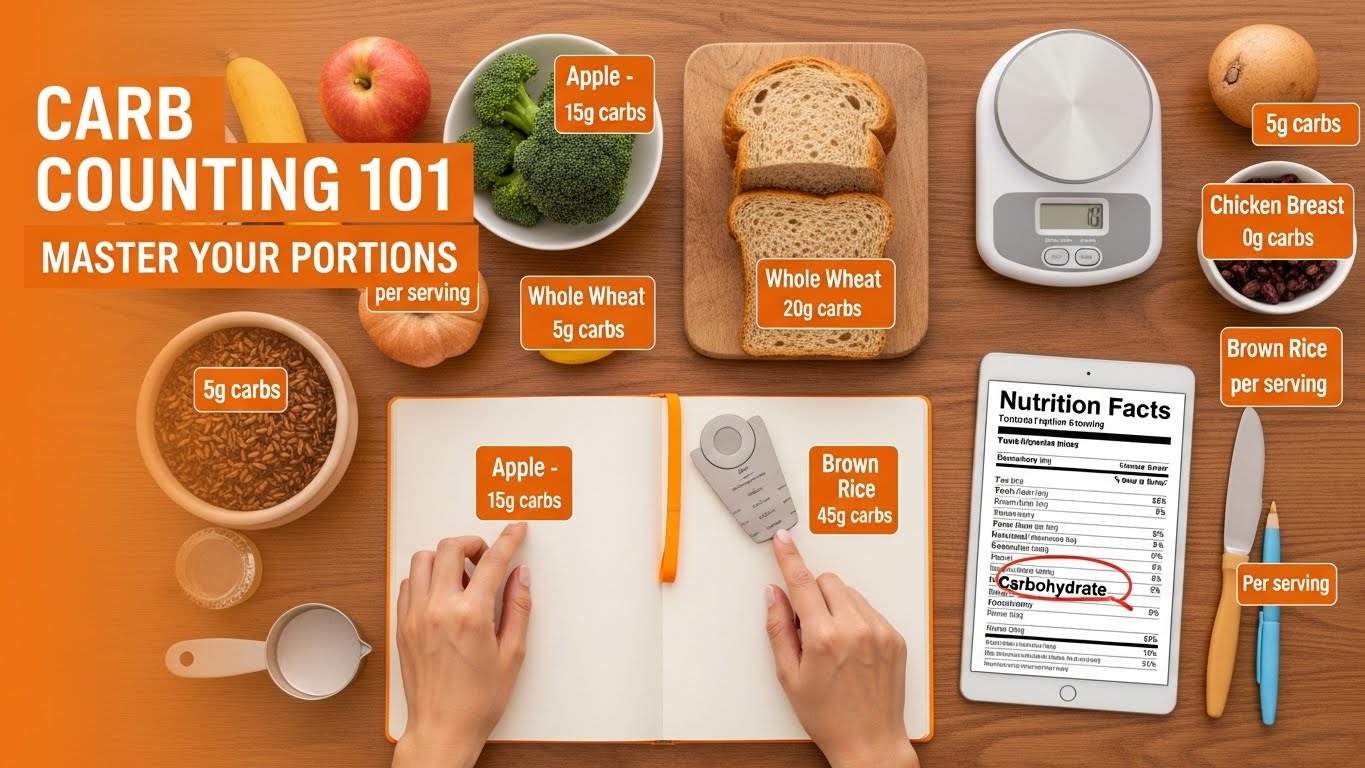
🎥 Watch: Carb Counting - The Essential Skill
Prefer watching? This video covers the key points from this article.
Key Takeaways
- Carb counting works: A 2025 meta-analysis shows it reduces HbA1c by 0.21% in Type 1 diabetes
- 15-20g carb estimation error is normal: Even with practice, expect some margin—consistency matters more than perfection
- Indian foods are carb-dense: 60-70% of Indian diet calories come from carbohydrates—awareness is crucial
- Three skill levels: Basic (consistent portions), intermediate (gram counting), advanced (insulin-to-carb ratios)
- Tools improve accuracy: Food scales, apps, and CGM feedback can cut estimation errors in half
If you've been diagnosed with diabetes, you've probably heard "watch your carbs" more times than you can count. But what does that actually mean in practice? Carb counting is the foundational skill that transforms vague dietary advice into actionable, precise diabetes management.
Whether you're eating a traditional Indian thali with roti and rice, grabbing a quick dosa for breakfast, or navigating a restaurant menu, understanding carbohydrate content puts you in control. A 2025 meta-analysis of 16 studies confirmed that carb counting significantly improves glycemic control—and this guide will teach you exactly how to do it.
Table of Contents
1. What is Carb Counting?
Carb counting (or carbohydrate counting) is a meal planning approach where you track the grams of carbohydrates in the foods you eat. Unlike calorie counting, which focuses on total energy, carb counting zeroes in on the macronutrient that has the most direct and immediate impact on blood glucose levels.
Definition
Carb Counting: A diabetes management technique that involves tracking grams of carbohydrates consumed per meal to predict blood sugar response and calculate appropriate insulin doses (if applicable).
The Science Behind Carb Counting
When you eat carbohydrates, your digestive system breaks them down into glucose, which enters your bloodstream. In people without diabetes, the pancreas responds by releasing insulin to shuttle glucose into cells. In diabetes, this process is impaired—either the body doesn't produce enough insulin (Type 1) or doesn't respond to it effectively (Type 2).
According to ADA 2025 Standards of Care, understanding your carbohydrate intake is fundamental to:
- Predicting post-meal blood sugar responses
- Calculating accurate insulin doses (for those on insulin)
- Maintaining consistent blood sugar patterns
- Making informed food choices
- Achieving target time in range (TIR)
Who Should Count Carbs?
| Diabetes Type | Carb Counting Level Needed | Why |
|---|---|---|
| Type 1 (on insulin) | Advanced (precise grams) | Must calculate insulin doses for each meal |
| Type 2 (on insulin) | Intermediate to Advanced | Insulin dosing requires carb awareness |
| Type 2 (on medications) | Basic to Intermediate | Consistent portions help medications work |
| Prediabetes | Basic (awareness) | Portion control and carb distribution |
| Gestational Diabetes | Intermediate | Precise control during pregnancy |
2. Why Carbohydrates Matter for Blood Sugar
Of the three macronutrients—carbohydrates, protein, and fat—carbs have the most significant and rapid impact on blood glucose. Understanding this relationship is the foundation of effective diabetes management.
The Macronutrient Blood Sugar Impact
| Macronutrient | Blood Sugar Impact | Timing | Conversion to Glucose |
|---|---|---|---|
| Carbohydrates | High (direct) | 15-30 minutes | ~100% converts to glucose |
| Protein | Low-Moderate | 3-4 hours | ~35-50% converts (slowly) |
| Fat | Minimal direct | 6-8 hours | ~10% converts (very slowly) |
India's Carb-Heavy Diet Reality
Understanding carb counting is especially critical in India, where carbohydrates form the foundation of most traditional diets. According to research from the National Institute of Nutrition, 60-70% of calories in the typical Indian diet come from carbohydrate-containing foods.
Common Indian staples and their carb profiles:
- Rice: The primary staple in South and East India
- Roti/Chapati: Wheat-based flatbread in North India
- Dal: Lentils contain both protein AND carbs (often overlooked)
- Potatoes: Used extensively in vegetable preparations
- Breakfast items: Dosa, idli, poha, upma—all carb-rich
This doesn't mean these foods are "bad"—but awareness of their carb content is essential for blood sugar management. The goal isn't elimination but informed consumption.
The Glycemic Index Factor
Not all carbs affect blood sugar equally. The Glycemic Index (GI) measures how quickly a food raises blood glucose:
- High GI (70-100): White rice, white bread, potatoes—rapid spike
- Medium GI (56-69): Basmati rice, roti, banana—moderate rise
- Low GI (0-55): Dal, vegetables, whole grains—gradual increase
According to research on South Indian foods, plain dosa has a high GI of 79.69, while vada sambar has a much lower GI of 36.89—demonstrating how preparation method and combinations matter.
3. The Three Levels of Carb Counting
Carb counting isn't one-size-fits-all. There are three distinct levels, and the right approach depends on your diabetes type, treatment, and goals.
Level 1: Basic Carb Counting (Carb Awareness)
Best for: Type 2 diabetes on oral medications, prediabetes, newly diagnosed
At this level, you're not counting exact grams—you're developing awareness of which foods contain carbs and maintaining consistent portions.
Key skills:
- Identify carb-containing foods (grains, fruits, starchy vegetables, milk, sweets)
- Recognize carb-free foods (meats, fish, eggs, non-starchy vegetables, oils)
- Use "carb servings" (1 serving = 15g carbs) rather than exact grams
- Maintain consistent carb amounts at each meal
Basic Carb Counting Goal
If you typically eat 4 carb servings (60g) at dinner, aim for 4 servings every dinner. Consistency helps your medications work predictably.
Level 2: Intermediate Carb Counting
Best for: Type 2 on fixed-dose insulin, gestational diabetes, those wanting tighter control
At this level, you count actual grams of carbohydrates and track them in a log or app.
Key skills:
- Read nutrition labels accurately
- Estimate carbs in unlabeled foods (restaurant meals, home-cooked food)
- Use measuring cups, food scales, and reference guides
- Track carb intake and correlate with blood sugar readings
Level 3: Advanced Carb Counting (Insulin-to-Carb Ratios)
Best for: Type 1 diabetes, Type 2 on multiple daily injections or insulin pumps
At this level, you use precise carb counts to calculate your mealtime insulin dose using an insulin-to-carb ratio (ICR).
Key skills:
- All intermediate skills plus:
- Calculate insulin doses based on carb intake
- Apply correction factors for high blood sugar
- Adjust ratios based on time of day, activity, and other factors
- Use insulin pump bolus calculators effectively
| Level | Precision | Time Investment | Tools Needed |
|---|---|---|---|
| Basic | Portions/servings | Low | Plate method, visual guides |
| Intermediate | Grams (±10g) | Moderate | Food scale, apps, labels |
| Advanced | Precise grams + ICR | High initially | Scale, CGM, pump/calculator |
4. Carb Values for Common Indian Foods
This is what you've been waiting for—practical carb counts for foods you actually eat. These values are based on standard serving sizes and research from the National Institute of Nutrition guidelines.
Grains and Breads
| Food | Serving Size | Carbs (g) | GI |
|---|---|---|---|
| Roti (wheat chapati) | 1 medium (30g flour) | 15-20 | 62 |
| White rice (cooked) | 1 cup (150g) | 45 | 73 |
| Basmati rice (cooked) | 1 cup (150g) | 45 | 58 |
| Brown rice (cooked) | 1 cup (150g) | 45 | 55 |
| Plain dosa | 1 medium | 30-35 | 80 |
| Idli | 2 pieces | 25-30 | 69 |
| Poha | 1 cup (150g) | 35-40 | 64 |
| Upma | 1 cup (150g) | 30-35 | 66 |
| Paratha (plain) | 1 medium | 25-30 | 52 |
| Puri | 2 pieces | 25-30 | 75 |
Dals and Legumes
Important: Many people forget that dal contains significant carbohydrates along with protein!
| Food | Serving Size | Carbs (g) | Protein (g) |
|---|---|---|---|
| Toor dal (cooked) | 1 cup (200g) | 35-40 | 14 |
| Moong dal (cooked) | 1 cup (200g) | 30-35 | 12 |
| Chana dal (cooked) | 1 cup (200g) | 40-45 | 15 |
| Rajma (cooked) | 1 cup (175g) | 40 | 15 |
| Chole (cooked) | 1 cup (165g) | 45 | 15 |
| Sambar (with vegetables) | 1 cup (200ml) | 15-20 | 6 |
Vegetables
| Food | Serving Size | Carbs (g) | Category |
|---|---|---|---|
| Potato (boiled) | 1 medium (150g) | 25-30 | Starchy |
| Aloo sabzi | 1 cup (150g) | 25-30 | Starchy |
| Bhindi (okra) | 1 cup (100g) | 7 | Non-starchy |
| Palak (spinach) | 1 cup (100g) | 3-4 | Non-starchy |
| Cauliflower | 1 cup (100g) | 5 | Non-starchy |
| Cabbage | 1 cup (100g) | 5-6 | Non-starchy |
| Karela (bitter gourd) | 1 cup (100g) | 4 | Non-starchy |
| Lauki (bottle gourd) | 1 cup (100g) | 3 | Non-starchy |
Low-Carb Indian Options
Diabetes-Friendly Low-Carb Foods
- Paneer: 1g carbs per 100g - excellent protein source
- Eggs: 0.6g carbs per egg
- Chicken tikka: Near-zero carbs (watch the marinade)
- Fish curry: 2-3g carbs (without potato)
- Raita: 6-8g carbs per cup
- Green salad: 3-5g carbs per cup
5. Understanding Insulin-to-Carb Ratios
If you're on mealtime (bolus) insulin, the insulin-to-carb ratio (ICR) is your most powerful tool. It tells you exactly how much insulin to take based on what you're eating.
What is an Insulin-to-Carb Ratio?
Definition
Insulin-to-Carb Ratio (ICR): The number of grams of carbohydrate covered by one unit of rapid-acting insulin. Expressed as 1:X, where X = grams of carbs per unit of insulin.
Examples:
- 1:10 ratio = 1 unit of insulin covers 10 grams of carbs
- 1:15 ratio = 1 unit of insulin covers 15 grams of carbs
- 1:8 ratio = 1 unit of insulin covers 8 grams of carbs
How to Calculate Your Mealtime Insulin
Formula: Meal carbs ÷ ICR = Insulin units needed
Example calculation:
- Your ICR: 1:10
- Meal: 2 rotis (40g) + 1 cup dal (35g) + vegetables (5g) = 80g total carbs
- Insulin needed: 80 ÷ 10 = 8 units of rapid-acting insulin
Factors That Affect Your ICR
Your ratio isn't fixed—it can vary based on:
| Factor | Effect on ICR | Example |
|---|---|---|
| Time of day | Morning often needs more insulin | 1:8 at breakfast, 1:12 at dinner |
| Activity level | Exercise increases sensitivity | 1:15 on gym days vs 1:10 normally |
| Illness/stress | May need more insulin | Ratio may drop to 1:8 during illness |
| Menstrual cycle | Varies through cycle | May need adjustment mid-cycle |
| Weight changes | Weight loss increases sensitivity | ICR may improve over time |
⚠️ Important Safety Note
Your insulin-to-carb ratio should ONLY be determined by your healthcare provider. This ratio is personalized based on your total daily insulin dose, insulin sensitivity, and other factors. Never copy someone else's ratio or guess your own.
6. Step-by-Step: How to Start Carb Counting
Ready to start? Here's a practical guide to building your carb counting skills progressively.
Week 1: Build Awareness
- Identify carb-containing foods: For one week, simply notice which foods in your meals contain carbohydrates. Don't count yet—just observe.
- Start a food journal: Write down what you eat at each meal. Note which items are carb sources.
- Learn the "free" foods: Identify foods you can eat without counting (most non-starchy vegetables, meats, fish, eggs, oils).
Week 2: Learn Portion Sizes
- Get a food scale: A digital kitchen scale (₹500-1500) is the single most useful carb counting tool.
- Measure your usual portions: Weigh your normal serving of rice, roti dough, dal—you may be surprised!
- Create personal references: "My usual katori of rice weighs 120g = 36g carbs"
Week 3: Start Counting
- Use a tracking app: Log your meals with carb counts (see app recommendations below)
- Focus on one meal first: Master carb counting for breakfast before tackling all meals
- Compare blood sugar response: Note how different carb amounts affect your readings
Week 4: Refine and Adjust
- Review patterns: Look at your food log and blood sugar data together
- Identify problem meals: Which meals cause unexpected spikes?
- Adjust portions: Make informed decisions about carb intake at different meals
💡 Track Carbs AND Blood Sugar Together
My Health Gheware lets you log meals alongside your CGM data, showing exactly how different foods and portions affect YOUR blood sugar—not generic estimates from a database.
Try Free →7. Tips for More Accurate Counting
Research shows the average carb estimation error is 15-20%. Here's how to improve your accuracy:
Use a Food Scale
This is the #1 accuracy booster. Studies show that visual estimation errors can be as high as 50% for some foods. A scale eliminates guesswork for:
- Raw ingredients before cooking (flour for rotis, rice before cooking)
- Portion sizes of prepared foods
- Fruits (especially variable sizes like bananas, mangoes)
Weigh Ingredients, Not Cooked Food
For homemade Indian food, weigh ingredients BEFORE cooking. Cooked volumes vary based on water absorption:
- 30g wheat flour = ~20g carbs (regardless of roti size after cooking)
- 50g raw rice = ~40g carbs (whether it yields 100g or 150g cooked)
Read Labels Carefully
According to Healthline's diabetes nutrition guide, the FDA recommends using total carbohydrates (not net carbs) for consistent diabetes management.
Label reading tips:
- Check serving size first—it may differ from your actual portion
- Total carbohydrates includes fiber, sugar, and starch
- If eating double the serving size, double the carbs
- Be wary of "per 100g" vs "per serving" confusion
Account for "Hidden" Carbs
Foods that contain carbs people often forget:
- Milk and curd: 12g carbs per cup
- Sauces and chutneys: 2-10g per tablespoon
- Dal and legumes: Significant carbs along with protein
- Fruits in raita: Pomegranate, grapes add carbs
- Onions in cooking: 8g carbs per medium onion
Use the Plate Method as a Visual Check
Even when counting grams, the plate method helps verify proportions:
- ½ plate: Non-starchy vegetables
- ¼ plate: Protein (paneer, dal, chicken, fish)
- ¼ plate: Carbohydrate (rice, roti, potato)
8. Common Carb Counting Mistakes
A 2024 review in PMC identified several common carb counting errors. Here's how to avoid them:
Mistake #1: Ignoring Dal and Legumes
The error: Treating dal as "just protein" and not counting its carbs.
Reality: One cup of cooked toor dal has 35-40g of carbs—equivalent to a cup of rice!
Fix: Always count dal carbs. A typical meal with rice AND dal can easily exceed 80g carbs.
Mistake #2: Underestimating Portion Sizes
The error: Thinking you're eating "1 roti" when your roti is actually 1.5x the standard size.
Reality: Homemade rotis vary from 25g to 50g of flour. That's 12g to 30g carbs—a huge range!
Fix: Weigh your dough balls before rolling. Standardize your roti size.
Mistake #3: Forgetting Cooking Oils Add Calories, Not Carbs
The error: Confusing calorie counting with carb counting.
Reality: Ghee and oils have zero carbs. They affect calories and can slow glucose absorption, but don't add to carb count.
Fix: Focus specifically on carbohydrates, not total calories, for blood sugar management.
Mistake #4: Not Adjusting for Fiber
The error: Either ignoring fiber completely or subtracting all fiber from total carbs.
Reality: The ADA recommends using TOTAL carbs. Fiber does slow absorption but individual responses vary.
Fix: Start with total carbs. Adjust based on YOUR blood sugar response to high-fiber foods.
Mistake #5: Skipping Tracking on "Bad" Days
The error: Only logging meals when eating "well."
Reality: The days you eat more are the most valuable for learning your body's responses.
Fix: Track everything. No judgment—just data.
Mistake #6: Not Accounting for Restaurant Portions
The error: Assuming restaurant portions match home-cooked amounts.
Reality: Restaurant dal makhani might have 60-80g carbs vs 35-40g at home. Biryanis often have 90-100g+ carbs.
Fix: Estimate restaurant portions at 1.5-2x home servings. Check post-meal blood sugar to calibrate.
9. Apps and Tools That Help
A 2025 study found that smartphone apps can significantly improve carb counting accuracy. Here are the best options:
General Carb Counting Apps
| App | Best For | Indian Food Database | Price |
|---|---|---|---|
| MyFitnessPal | General nutrition tracking | Limited | Free / Premium ₹399/mo |
| HealthifyMe | Indian food specialists | Excellent | Free / Pro ₹299/mo |
| Carb Manager | Low-carb/keto diets | Moderate | Free / Premium $40/yr |
| MySugr | Diabetes-specific | Limited | Free / Pro ₹399/mo |
| Fitterfly | Indian diabetes program | Excellent | Subscription-based |
AI-Powered Tools (2025)
According to Diabetes Care research, AI-powered carb counting tools are showing promising accuracy improvements:
- Photo-based estimation: Snap a photo, get carb estimates
- Machine learning: Learns from your corrections over time
- Integration with CGM: Correlates carb intake with actual blood sugar response
Essential Physical Tools
- Digital kitchen scale (₹500-1500): Most important tool after your glucometer
- Measuring cups and spoons: For liquids and consistent portions
- Portion control plates: Visual guides for the plate method
- Carb reference cards: Laminated cards with common food values for your wallet
🔗 Connect Your Food Log to Your CGM
My Health Gheware correlates your nutrition logging with continuous glucose data, showing personalized carb impact—not just generic database values. See exactly how YOUR body responds to different foods and portions.
Start Tracking Free →10. Frequently Asked Questions
What is carb counting for diabetes?
Carb counting is a meal planning technique that tracks the grams of carbohydrates consumed at each meal to help manage blood sugar levels. For people with diabetes, carbs have the most significant impact on blood glucose, so knowing how many carbs you eat allows for better insulin dosing and more stable blood sugar throughout the day.
How many carbs should a diabetic eat per day?
The ADA recommends an individualized approach rather than a one-size-fits-all number. Common targets range from 45-60 grams per meal (135-180g/day) for moderate plans, to under 130g/day for low-carb approaches, or under 50g/day for very low-carb/keto. Work with your healthcare team to determine your optimal carb intake based on your medications, activity level, and blood sugar goals.
What is an insulin-to-carb ratio?
An insulin-to-carb ratio (ICR) tells you how many grams of carbohydrates are covered by one unit of rapid-acting insulin. For example, a 1:10 ratio means 1 unit of insulin covers 10 grams of carbs. Common ratios range from 1:5 (more insulin-resistant) to 1:20 (more insulin-sensitive). Your healthcare provider calculates your personal ratio based on your response to insulin and total daily dose.
How accurate is carb counting?
Research shows the average person with diabetes estimates meal carbohydrates within about 15-20% of actual values. While this margin exists, consistent carb counting still improves glycemic control significantly. A 2025 meta-analysis found carb counting reduced HbA1c by 0.21% in Type 1 diabetes. Using food scales, apps, and standardized portions improves accuracy considerably.
Should I count total carbs or net carbs?
The FDA and ADA recommend using total carbohydrates, not net carbs. Net carbs subtract fiber and sugar alcohols from total carbs, but their effect on blood sugar varies between individuals. For consistent insulin dosing and blood sugar management, total carbohydrates provide a more reliable baseline. You can adjust doses based on your personal response to high-fiber foods.
How many carbs are in 1 roti (chapati)?
One medium-sized roti (wheat chapati, about 30g flour) contains approximately 15-20 grams of carbohydrates. The exact amount varies by size and thickness. For reference: small roti (25g) = 12-15g carbs, medium roti (30g) = 15-20g carbs, large roti (40g) = 20-25g carbs. Using a kitchen scale to weigh flour before cooking improves accuracy.
How many carbs are in 1 cup of cooked rice?
One cup (150g) of cooked white rice contains approximately 45 grams of carbohydrates. Brown rice has similar carb content (about 45g per cup) but with more fiber (3.5g vs 0.6g). Basmati rice has a slightly lower glycemic index than regular white rice. For portion control, many diabetes educators recommend limiting rice to 1/2 cup (22-23g carbs) per meal.
What foods have zero carbs?
Foods with zero or negligible carbs include: most meats (chicken, fish, mutton, eggs), pure fats (ghee, butter, olive oil, coconut oil), and some vegetables in small amounts (spinach, cucumber, lettuce). However, be aware that cooking methods and marinades can add carbs. Paneer has about 1g carbs per 100g, making it a low-carb protein option popular in Indian cuisine.
Do I need to count carbs if I'm on metformin only?
While carb counting is most critical for those on insulin, it's beneficial for everyone with diabetes. People on metformin or other oral medications can use basic carb counting to keep portions consistent, which helps medications work more effectively. You don't need precise gram counts—focusing on consistent carb portions at each meal is often sufficient for Type 2 diabetes managed with oral medications.
What apps help with carb counting?
Popular carb counting apps include MyFitnessPal, Carb Manager, and MySugr for general tracking. For Indian foods specifically, HealthifyMe and Fitterfly have extensive databases. My Health Gheware integrates nutrition logging with CGM data to show exactly how different carb amounts affect YOUR blood sugar, providing personalized insights beyond generic databases.
Mastering Carb Counting: Your Path to Better Control
Carb counting isn't about restriction—it's about knowledge and empowerment. When you understand the carbohydrate content of your meals, you move from reactive diabetes management (wondering why your blood sugar spiked) to proactive control (predicting and preventing spikes before they happen).
The evidence is clear: the 2025 meta-analysis showed significant HbA1c improvements for those who master this skill. But beyond the numbers, carb counting gives you freedom—the freedom to enjoy your favorite foods while staying in control.
Start today with these three steps:
- Get a digital food scale (best ₹500 investment you'll make)
- Weigh your usual portions for one week—just observe
- Download a tracking app with Indian food database
Remember: perfection isn't the goal. Consistency and gradual improvement are. Even reducing your carb estimation error from 30% to 15% can significantly improve your blood sugar control.
🎯 See How Carbs Affect YOUR Blood Sugar
My Health Gheware correlates your nutrition logging with your CGM data, showing personalized carb responses—not generic estimates. Discover your optimal carb portions for different meals.
Start Your Free Trial →