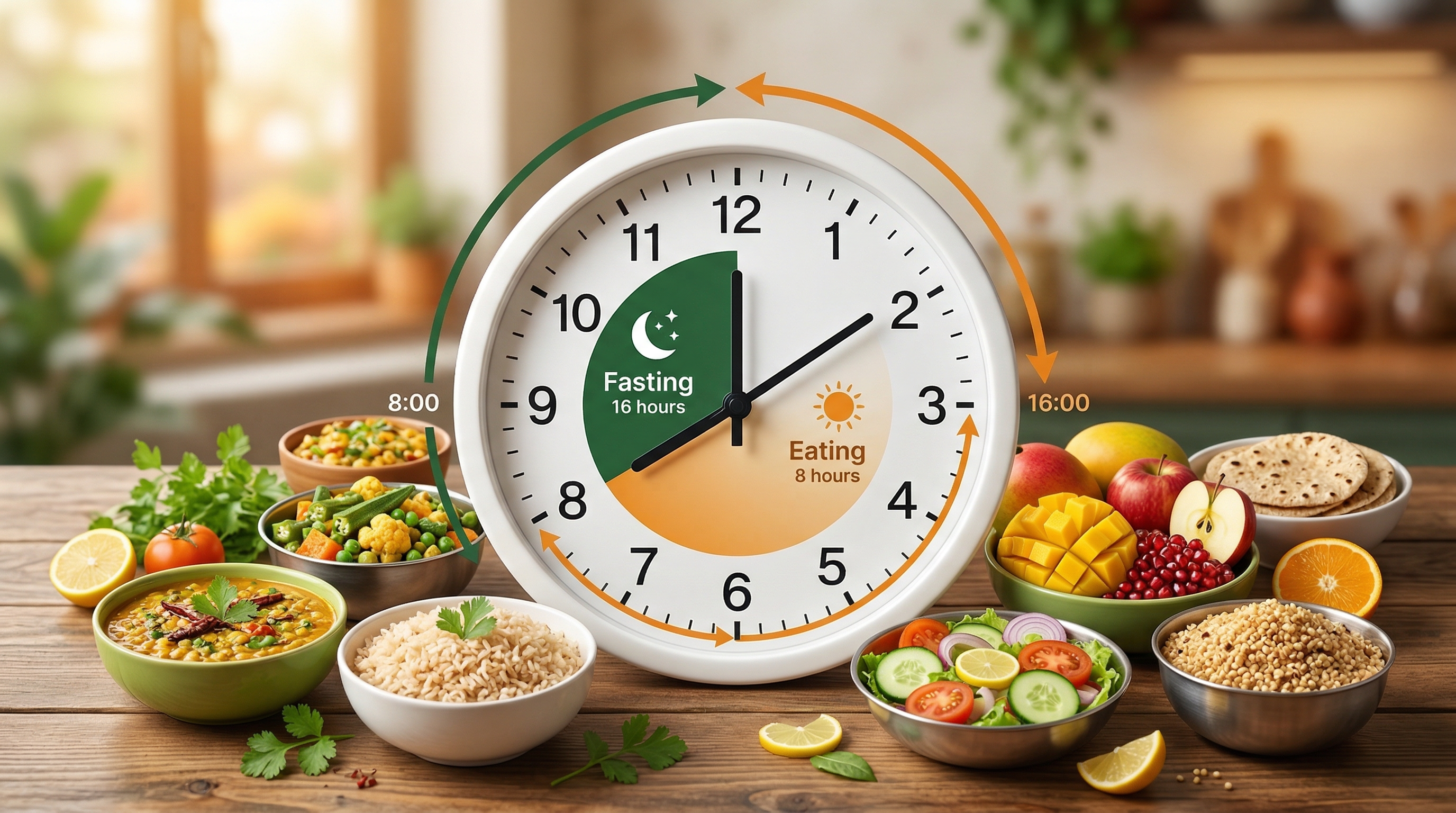
Intermittent fasting (IF) is one of the most searched health topics in India right now — and for good reason. With 101 million diabetics in India and growing, people are desperate for strategies that go beyond just popping pills. But is skipping meals actually safe when you have diabetes?
The short answer: it depends. For many Type 2 diabetics on metformin alone, intermittent fasting can be a game-changer — reducing HbA1c by up to 1.2%, improving insulin sensitivity, and even helping some patients reduce their medication. But for others — especially those on insulin or sulfonylureas — fasting without proper medical guidance can trigger dangerous hypoglycemia.
This guide covers everything Indian diabetics need to know: which IF methods work best, who should avoid it, how to adjust medications, Indian-specific meal plans, and special guidance for Ramadan fasting.
📋 Table of Contents
- What Is Intermittent Fasting?
- The Science: How IF Affects Blood Sugar
- Best IF Methods for Diabetics
- Who Should NOT Fast (Critical Safety)
- Medication Adjustments During IF
- 7-Day Indian IF Meal Plan for Diabetics
- Ramadan Fasting with Diabetes
- What CGM Data Shows During Fasting
- How to Start IF Safely
- FAQs
What Is Intermittent Fasting?
Intermittent fasting isn't a diet — it's an eating pattern. Instead of restricting what you eat, you restrict when you eat. You alternate between periods of eating and fasting, giving your body extended breaks from digesting food.
Interestingly, fasting is deeply embedded in Indian culture. From Ekadashi and Navratri fasts to Ramadan and Karwa Chauth, millions of Indians already practice some form of fasting regularly. The modern intermittent fasting movement is essentially a structured, evidence-based version of what our grandparents have been doing for centuries.
The key difference for diabetics: we need to be strategic and medically supervised, not just spiritually motivated.
Common IF Methods
| Method | How It Works | Diabetes Safety | Best For |
|---|---|---|---|
| 16:8 | Eat within 8 hours, fast 16 hours | 🟢 Safest | Most Type 2 diabetics |
| 14:10 | Eat within 10 hours, fast 14 hours | 🟢 Very safe | Beginners, elderly diabetics |
| 5:2 | Normal eating 5 days, 500-600 cal for 2 days | 🟡 Moderate risk | Experienced fasters |
| OMAD | One Meal A Day | 🔴 High risk | NOT recommended for diabetics |
| Alternate Day | Fast every other day | 🔴 High risk | NOT recommended for diabetics |
| Extended (24-72h) | Multi-day fasting | 🔴 Dangerous | NEVER for diabetics |
The Science: How Intermittent Fasting Affects Blood Sugar
IF works through multiple mechanisms that are particularly relevant for Type 2 diabetes:
1. Improved Insulin Sensitivity
During fasting, insulin levels drop significantly (by 20-31%). This gives your cells a "break" from constant insulin exposure, which resensitizes insulin receptors. After 2-4 weeks of IF, cells respond better to insulin, meaning your body needs less insulin to process the same amount of glucose.
2. Reduced Insulin Resistance
Insulin resistance is the core problem in Type 2 diabetes. When you eat constantly (the typical Indian pattern of chai-biscuit at 7 AM, breakfast at 9, lunch at 1, snack at 4, dinner at 9, and another chai before bed), your pancreas is continuously pumping insulin. This chronic insulin elevation worsens resistance over time.
Fasting breaks this cycle. During the 14-16 hour fast, insulin levels fall to baseline, allowing your cells to "reset" their sensitivity.
3. Autophagy — Cellular Cleanup
After 12-16 hours of fasting, your body activates autophagy — a process where cells clean up damaged components, including dysfunctional mitochondria and misfolded proteins. This is particularly important for diabetics because damaged beta cells in the pancreas can be partially repaired through autophagy.
4. Weight Loss Without Calorie Counting
Most Indians with Type 2 diabetes are overweight (BMI >25). IF naturally reduces caloric intake by 15-25% without the need for tedious calorie counting. In Indian studies, IF participants lost an average of 3-5 kg over 12 weeks — with most of the loss coming from visceral (belly) fat, which is the most metabolically dangerous type.
5. Reduced Dawn Phenomenon
Many diabetics experience the "dawn phenomenon" — elevated morning blood sugar (140-180 mg/dL) caused by overnight liver glucose release. IF, particularly when combined with an earlier dinner (before 7 PM), can reduce dawn phenomenon by 20-35 mg/dL because the extended fast allows overnight insulin to work more effectively.
Best IF Methods for Indian Diabetics
🥇 The 16:8 Method — Gold Standard for Diabetics
🟢 Safety: HIGH for most Type 2 diabeticsWhy it's best for Indians: The 10 AM to 6 PM eating window aligns perfectly with Indian meal culture — a late breakfast/brunch at 10, lunch at 1-2 PM, and early dinner by 5:30-6 PM. You skip the early morning chai and the late-night dinner, which are the two biggest blood sugar disruptors anyway.
Expected results (12 weeks):
- Fasting glucose: ↓15-25 mg/dL
- HbA1c: ↓0.5-0.8%
- Weight: ↓2-4 kg
- Insulin sensitivity: ↑25-36%
- Triglycerides: ↓15-20%
🥈 The 14:10 Method — Beginner-Friendly
🟢 Safety: VERY HIGH — safest optionPerfect for: Diabetics over 60, those new to fasting, patients on multiple medications, or anyone who finds 16:8 too aggressive. Essentially, you're just skipping late-night eating and having an early dinner — something most diabetes doctors recommend anyway.
Expected results (12 weeks):
- Fasting glucose: ↓10-18 mg/dL
- HbA1c: ↓0.3-0.5%
- Weight: ↓1-3 kg
🥉 The 5:2 Method — For Experienced Fasters
🟡 Safety: MODERATE — requires medical supervisionHow it works for Indians: Eat normally 5 days a week. On 2 non-consecutive days (e.g., Monday and Thursday), limit intake to 500-600 calories. On restricted days, a typical Indian plan might be: moong dal khichdi (200 cal) for lunch and vegetable soup with 1 roti (300 cal) for dinner.
Who Should NOT Do Intermittent Fasting
This is the most important section of this article. IF is not safe for everyone with diabetes.
- Type 1 Diabetes — high risk of diabetic ketoacidosis (DKA)
- On insulin therapy — without careful dose adjustment by your endocrinologist
- On sulfonylureas (glimepiride, gliclazide, glipizide) — these force insulin release regardless of food intake, causing hypoglycemia during fasts
- History of severe hypoglycemia (blood sugar <54 mg/dL) in the past 6 months
- Hypoglycemia unawareness — you don't feel symptoms when blood sugar drops
- Pregnant or breastfeeding women with gestational diabetes
- Advanced kidney disease (eGFR <30)
- History of eating disorders
- Elderly (>75 years) with frailty or malnutrition risk
- Diabetic ketoacidosis (DKA) history in the past year
✅ IF Is Generally Safe If You:
- Have Type 2 diabetes controlled with metformin alone
- Have Type 2 diabetes controlled with diet and exercise
- Have prediabetes or metabolic syndrome
- Are on DPP-4 inhibitors (sitagliptin, vildagliptin) — these are weight-neutral and don't cause hypos
- Are on SGLT2 inhibitors (dapagliflozin, empagliflozin) — generally safe, but increase water intake
- Are on GLP-1 receptor agonists (liraglutide, semaglutide) — actually complement IF well
- Have a BMI >25 and want to lose weight
- Have your doctor's approval
Medication Adjustments During Intermittent Fasting
Never adjust your diabetes medications without consulting your doctor. That said, here's what your endocrinologist will likely consider:
| Medication | Hypo Risk During IF | Typical Adjustment |
|---|---|---|
| Metformin | 🟢 Very Low | Take with first meal of eating window. No dose change needed. |
| Sitagliptin / Vildagliptin (DPP-4i) | 🟢 Low | Usually no change. Take with first meal. |
| Dapagliflozin / Empagliflozin (SGLT2i) | 🟢 Low | No dose change, but drink extra water (risk of dehydration during fast). |
| Liraglutide / Semaglutide (GLP-1 RA) | 🟢 Very Low | No change. These complement IF — they reduce appetite naturally. |
| Pioglitazone (TZD) | 🟢 Low | No change typically. |
| Glimepiride / Gliclazide (SU) | 🔴 HIGH | Reduce dose by 50% or switch timing. Discuss with doctor. |
| Glipizide (SU) | 🔴 HIGH | May need to skip morning dose during fast. Doctor must decide. |
| Basal Insulin (Lantus, Tresiba) | 🟡 Moderate | May need 10-20% dose reduction. Monitor closely. |
| Rapid Insulin (NovoRapid, Humalog) | 🔴 HIGH | Skip the dose for skipped meals. Only inject with meals you eat. |
7-Day Indian IF Meal Plan for Diabetics (16:8)
This meal plan follows a 10 AM - 6 PM eating window, with approximately 1,400-1,600 calories per day. All recipes use commonly available Indian ingredients.
🗓️ Day 1 (Monday)
10:00 AM — Meal 1: 2 moong dal chilla (pancakes) + mint chutney + 1 cup masala chai (low sugar) — 320 cal
1:00 PM — Meal 2 (Lunch): 1 cup brown rice + palak paneer (150g) + cucumber raita + salad — 480 cal
4:00 PM — Snack: 10 almonds + 1 small apple — 180 cal
5:45 PM — Meal 3 (Early Dinner): 2 bajra roti + lauki (bottle gourd) sabzi + dal tadka — 420 cal
Total: ~1,400 cal | Carbs: 160g | Protein: 55g | Fiber: 28g
🗓️ Day 2 (Tuesday)
10:00 AM — Meal 1: Vegetable upma (semolina) with peanuts + 1 boiled egg — 350 cal
1:00 PM — Meal 2: 2 jowar roti + bhindi (okra) sabzi + chana dal + buttermilk — 450 cal
4:00 PM — Snack: 1 cup roasted makhana (fox nuts) — 120 cal
5:45 PM — Meal 3: Grilled fish/paneer tikka + mixed vegetable salad + 1 multigrain roti — 450 cal
Total: ~1,370 cal | Carbs: 145g | Protein: 62g | Fiber: 25g
🗓️ Day 3 (Wednesday)
10:00 AM — Meal 1: Besan chilla (2 pieces) + green chutney + curd (100g) — 310 cal
1:00 PM — Meal 2: Rajma (kidney beans) curry + 1 cup brown rice + onion-tomato salad — 480 cal
4:00 PM — Snack: 1 cup sprouts chaat with lemon — 140 cal
5:45 PM — Meal 3: Methi (fenugreek) paratha (2, small) + baingan bharta + curd — 430 cal
Total: ~1,360 cal | Carbs: 155g | Protein: 52g | Fiber: 30g
🗓️ Day 4 (Thursday)
10:00 AM — Meal 1: Poha (flattened rice) with peanuts and vegetables + green tea — 280 cal
1:00 PM — Meal 2: 2 ragi (finger millet) roti + palak dal + karela (bitter gourd) sabzi + salad — 440 cal
4:00 PM — Snack: Handful of walnuts (6-7) + 1 guava — 200 cal
5:45 PM — Meal 3: Chicken/soya curry (150g) + cauliflower rice + raita — 480 cal
Total: ~1,400 cal | Carbs: 140g | Protein: 65g | Fiber: 26g
🗓️ Day 5 (Friday)
10:00 AM — Meal 1: Idli (3) + sambhar + coconut chutney — 340 cal
1:00 PM — Meal 2: Chole (chickpea curry) + 1 small kulcha/roti + onion salad — 470 cal
4:00 PM — Snack: 1 small banana + 5 cashews — 170 cal
5:45 PM — Meal 3: Moong dal khichdi + kadhi + papad — 400 cal
Total: ~1,380 cal | Carbs: 165g | Protein: 48g | Fiber: 24g
🗓️ Day 6 (Saturday)
10:00 AM — Meal 1: Oats chilla (2) + tomato chutney + paneer cubes (50g) — 360 cal
1:00 PM — Meal 2: Dal makhani (controlled oil) + 1 cup jeera rice + salad — 500 cal
4:00 PM — Snack: Masala roasted chana (1/4 cup) — 130 cal
5:45 PM — Meal 3: Tandoori chicken/paneer (150g) + mixed veg stir-fry + 1 roti — 420 cal
Total: ~1,410 cal | Carbs: 148g | Protein: 60g | Fiber: 22g
🗓️ Day 7 (Sunday)
10:00 AM — Meal 1: Dosa (2, small) + sambhar + peanut chutney — 380 cal
1:00 PM — Meal 2: Mixed veg biryani (brown rice, 1 cup) + raita + boiled egg — 520 cal
4:00 PM — Snack: 1 cup chaas (buttermilk) + 1 small pear — 100 cal
5:45 PM — Meal 3: Toor dal + tinde ki sabzi + 2 bajra roti — 400 cal
Total: ~1,400 cal | Carbs: 162g | Protein: 50g | Fiber: 25g
- Always eat protein first at each meal — it slows glucose absorption
- Add a 10-minute walk after lunch and dinner
- Use 1 teaspoon fenugreek seeds soaked overnight — drink the water at 10 AM with your first meal
- Cook with cold-pressed mustard oil or coconut oil instead of refined oil
- Keep glucose tablets handy during fasting hours, especially in the first week
Ramadan Fasting with Diabetes — Special Guidance
Ramadan fasting is unique: you fast from dawn (Suhoor/Sehri) to sunset (Iftar), typically 12-15 hours in India depending on the season and location. Unlike 16:8 IF, you also cannot drink water during the fast — which adds dehydration risk.
IDF-DAR Risk Categories for Ramadan Fasting
| Risk Category | Description | Fasting Recommendation |
|---|---|---|
| Very High Risk | Type 1, on insulin with frequent hypos, DKA in past year, pregnant | 🔴 Must NOT fast |
| High Risk | Poorly controlled Type 2 (HbA1c >10%), on SU + insulin, advanced kidney disease | 🔴 Should NOT fast |
| Moderate Risk | Well-controlled Type 2 on SU or insulin (stable doses) | 🟡 Can fast with medical supervision |
| Low Risk | Well-controlled Type 2 on metformin/DPP-4i alone, diet-controlled | 🟢 Can fast with standard precautions |
Suhoor (Pre-Dawn Meal) Tips for Diabetics
- Eat complex carbs + protein + healthy fat: e.g., 2 eggs + 1 multigrain roti + a handful of almonds
- Include slow-digesting foods: oats, barley, whole wheat — these release glucose gradually over 6-8 hours
- Drink 2-3 glasses of water — hydration is critical
- Avoid fried foods, white rice, and sweets — they cause a rapid spike followed by a crash
- Take metformin with Suhoor (not on an empty stomach)
Iftar (Breaking the Fast) Tips for Diabetics
- Break with 2-3 dates + water (dates provide quick glucose without the spike of processed sugar)
- Wait 15-20 minutes before the main meal — this prevents overeating
- Avoid the traditional fried samosas, pakoras, and jalebis — have them in very small portions only
- Eat protein-rich Iftar: grilled chicken, chana chaat, paneer tikka, dahi vada
- Monitor blood sugar before Iftar and 2 hours after
- Blood sugar drops below 70 mg/dL — eat sugar/dates and recheck
- Blood sugar rises above 300 mg/dL
- You feel dizzy, confused, or shaky (hypoglycemia symptoms)
- You develop nausea, vomiting, or abdominal pain (possible DKA)
Islam explicitly permits breaking the fast for medical reasons. Your health comes first.
What CGM Data Shows During Intermittent Fasting
Continuous Glucose Monitors (CGMs) give us real-time data on how IF affects blood sugar throughout the day. Here's what the data consistently shows:
Typical CGM Pattern on 16:8 IF (Indian Diabetic)
- 6-10 AM (fasting): Blood sugar stable at 90-120 mg/dL. Dawn phenomenon may cause a small rise (10-20 mg/dL) around 6-7 AM, but it resolves by 9 AM without food.
- 10 AM (first meal): Post-meal spike to 140-170 mg/dL. Returns to baseline by 12 PM.
- 1 PM (lunch): Spike to 150-180 mg/dL. The post-lunch walk brings it down faster.
- 4 PM (snack): Minimal spike (10-20 mg/dL) if protein/nut-based snack.
- 6 PM (early dinner): Spike to 140-165 mg/dL. By 9 PM, back to 100-120 mg/dL.
- 9 PM - 6 AM (overnight fast): Gradual decline to 85-105 mg/dL. This is the most therapeutic window — your body is burning fat and repairing cells.
Week 1 vs. Week 4 Comparison
| Metric | Week 1 | Week 4 | Change |
|---|---|---|---|
| Average Glucose | 152 mg/dL | 128 mg/dL | ↓24 mg/dL |
| Fasting Glucose | 135 mg/dL | 112 mg/dL | ↓23 mg/dL |
| Time in Range | 65% | 82% | ↑17% |
| Post-Meal Peak | 195 mg/dL | 168 mg/dL | ↓27 mg/dL |
| Glucose Variability (CV) | 32% | 24% | ↓8% |
How to Start Intermittent Fasting Safely — Step by Step
Week 1-2: The Gentle Start (12:12)
- Talk to your doctor. Show them this article. Get medication adjustments if needed.
- Start with 12:12 — eat between 8 AM and 8 PM. This is just "no late-night eating."
- Monitor blood sugar 3-4 times daily: morning fasting, before lunch, 2 hours after lunch, and before bed.
- Keep a food and blood sugar diary — this helps you and your doctor see patterns.
- Keep glucose tablets or sugar handy at all times.
Week 3-4: Move to 14:10
- If Week 1-2 went well (no hypos, stable sugars), narrow the window to 8 AM - 6 PM.
- This means dinner by 6 PM — which also gives you the benefit of early dinner (see our walking after meals guide).
- Continue monitoring blood sugar daily.
Week 5+: Graduate to 16:8
- Push breakfast to 10 AM, keeping dinner at 6 PM.
- During the 6 PM - 10 AM fast: only water, black coffee, or green tea.
- You'll likely notice reduced hunger by this point — your body has adapted to burning fat during the fast.
- Reduce blood sugar monitoring to 2 times daily once patterns are stable.
Signs IF Is Working for You
- Fasting blood sugar consistently below 120 mg/dL
- Post-meal spikes reduced by 20+ mg/dL
- Weight loss of 0.5-1 kg per week
- Improved energy and mental clarity during fasting hours
- Reduced hunger and cravings (especially for sweets)
- HbA1c dropping at your next 3-month check
Signs You Should Stop IF
- Frequent hypoglycemia (blood sugar <70 mg/dL more than twice a week)
- Feeling dizzy, shaky, or confused during fasting hours
- Binge eating during the eating window (eating more than you normally would)
- Blood sugar consistently above 250 mg/dL (your body may need more consistent food intake)
- Obsessive thoughts about food or anxiety around eating
Frequently Asked Questions
Can I drink chai during the fasting window?
Black tea or green tea without sugar or milk — yes. Regular Indian chai with milk and sugar — no. Milk contains lactose (sugar) and protein, both of which break the fast. If you must have chai, have it during your eating window. A good alternative: black coffee with a pinch of cinnamon — cinnamon itself has mild blood sugar-lowering properties.
Will I feel weak during fasting? How do I handle it?
The first 3-5 days are the hardest. Your body is switching from glucose-burning to fat-burning mode. You may feel mild hunger, irritability, or low energy. This is normal and passes by Week 2 for most people. Stay well-hydrated (2-3 litres of water during eating hours), and ensure your meals are nutrient-dense. If you feel genuinely weak or shaky (not just hungry), check your blood sugar — it may be a hypo.
Can I exercise during the fasting window?
Light to moderate exercise (walking, yoga, stretching) is fine and even beneficial during fasting — it enhances fat burning. Avoid intense exercise (running, heavy weights, HIIT) during the fast, especially in the first 2 weeks. If you exercise during the fast, monitor blood sugar before and after. The best time to exercise is 30-60 minutes before breaking your fast — you'll have your meal right after to refuel.
Is IF safe during Indian festivals (Navratri, Karwa Chauth)?
Traditional Navratri fasting (eating fruits, sabudana, kuttu) can actually spike blood sugar because these "fasting foods" are high-glycemic. If you're doing IF + Navratri, choose low-GI fasting foods: makhana, raw banana, sweet potato, samak rice (barnyard millet), and plenty of curd. Avoid sabudana khichdi and fruit-based desserts. For Karwa Chauth (full-day fast), diabetics should consult their doctor — a full-day fast carries hypoglycemia risk.
How long should I continue intermittent fasting?
IF is a lifestyle change, not a short-term diet. Most research showing sustained benefits (HbA1c reduction, weight maintenance) involves 6-12 months of consistent practice. Many people adopt 16:8 as their permanent eating pattern. If your blood sugar normalizes and medication doses reduce, you're on the right track — don't stop IF just because your numbers improved. That's like stopping exercise because you got fit.
📱 Track Your IF Journey with My Health Gheware
Log your meals, fasting windows, and blood sugar readings all in one place. See how IF impacts your glucose trends with beautiful charts and CGM integration.
Start Tracking Free →